

When it comes to mental health, we have learned to look inward first.
So we ask ourselves things like: Am I sleeping enough? Am I setting my boundaries? Am I moving enough? Could I handle stress better? Do I need a break, coaching, or therapy?
At the same time, another question keeps getting more important: What role do the conditions we live and work in actually play?
Workload. Economic security. Care work. Discrimination. Decision-making power. Social expectations.
That is an important shift in perspective.
But maybe, between these two ways of seeing, there is something we keep overlooking.
Between the individual and the system, there is also the We.
Well-being doesn't only grow inside ourselves. It also grows in how we are together, and in the structures that shape our life together.
Many responses to overload are aimed at the individual first.
Under stress, we learn stress management. When we're overwhelmed, we're told to set boundaries. When we feel insecure, we work on our resilience. When we're exhausted, we're supposed to recover better.
The problem isn't that these answers are wrong.
It gets difficult when they remain the only answers. Then a difficult situation quickly turns into a personal assignment.
When someone is constantly overloaded, we ask: How can this person become more resilient?
But we could also ask: Why does this situation demand so much resilience from us in the first place?
Among the psychosocial risks to mental health at work, the World Health Organization lists high workloads, low control over one's own work, job insecurity, discrimination, and a lack of support.
So our environment is no neutral stage on which we simply take care of ourselves. It shapes us profoundly.
Once we take our eyes off the individual, we quickly land on structures.
Who holds decision-making power? Who has time and money? Who can afford to work less? Who takes on care work? Who carries the risks? Which behaviours do our institutions reward?
These questions are crucial.
Care work in particular shows how people try to look after their well-being from very different starting points. Data from Germany's Federal Statistical Office continues to show differences in how much unpaid care work people take on in Germany.
The advice "Set your boundaries" means one thing for someone with financial security and room to decide, and something else for someone whose livelihood depends on the very situation they would need to set a boundary against.
But if we only distinguish between individual and systemic change, we may overlook a third level that is just as important.
This level is created anew every day, and we can shape it directly: our relationships with one another.
Whether I can voice a boundary doesn't only depend on whether I have learned to set boundaries.
It also depends on what happens when I voice it. Is it respected? Do I have to defend it? Will the other person try to talk me out of it? Does my boundary have consequences for our relationship?
Whether I speak up in a team doesn't only depend on my self-confidence. It also depends on whether disagreement is genuinely welcome.
Whether I ask for support doesn't only depend on whether I'm "good at accepting help". It also depends on what I experienced the last times I opened up to other people.
Whether I feel I belong is no skill I can develop on my own. Belonging needs other people.
And with that, the question shifts once more.
Not only: What do I need?
And not only: What would have to change structurally?
But also: What kind of relationship dynamics and what social conditions do we need to foster collective well-being?
Trust or caution? Reciprocity or competition? Belonging or exclusion? Room to act or dependency? Curiosity or judgement?
The World Health Organization describes social connection as an important factor for health and well-being, and now explicitly treats loneliness and social isolation as public health issues.
So our relationships are more than the backdrop of our well-being. They are part of its conditions.
Over the past few years, we have learned a lot about taking our own needs seriously.
My boundaries. My mental health. My needs. My growth.
That can be liberating.
But maybe a new question grows out of it: What do we do with all this self-awareness once we meet each other again?
Because at some point, my boundary meets yours. My need meets your need. My freedom meets your dependency. My decision meets the consequences for others.
That is why well-being and belonging can't be a purely individual project. The World Health Organization stresses that social connection and supportive environments are central factors for mental health (World Health Organization, 2025).
That doesn't mean we are responsible for other people's mental health.
But we constantly influence the conditions under which others try to live healthy lives – as a colleague, as a manager, as a friend, as a partner, as part of a community or organisation.
So maybe what we need isn't only self-care, but also more shared care.
One example: you notice that someone is often quiet in meetings, and afterwards you ask how they're doing and whether they'd like some support. Or among friends, we pay attention not only to what does each of us good, but also to how we shape our time together so that everyone feels at ease. Small gestures like these show that care is something that happens between people.
Not in the sense of: "I have to make sure you're always okay."
But: I can help shape what it's like to be here together with others.
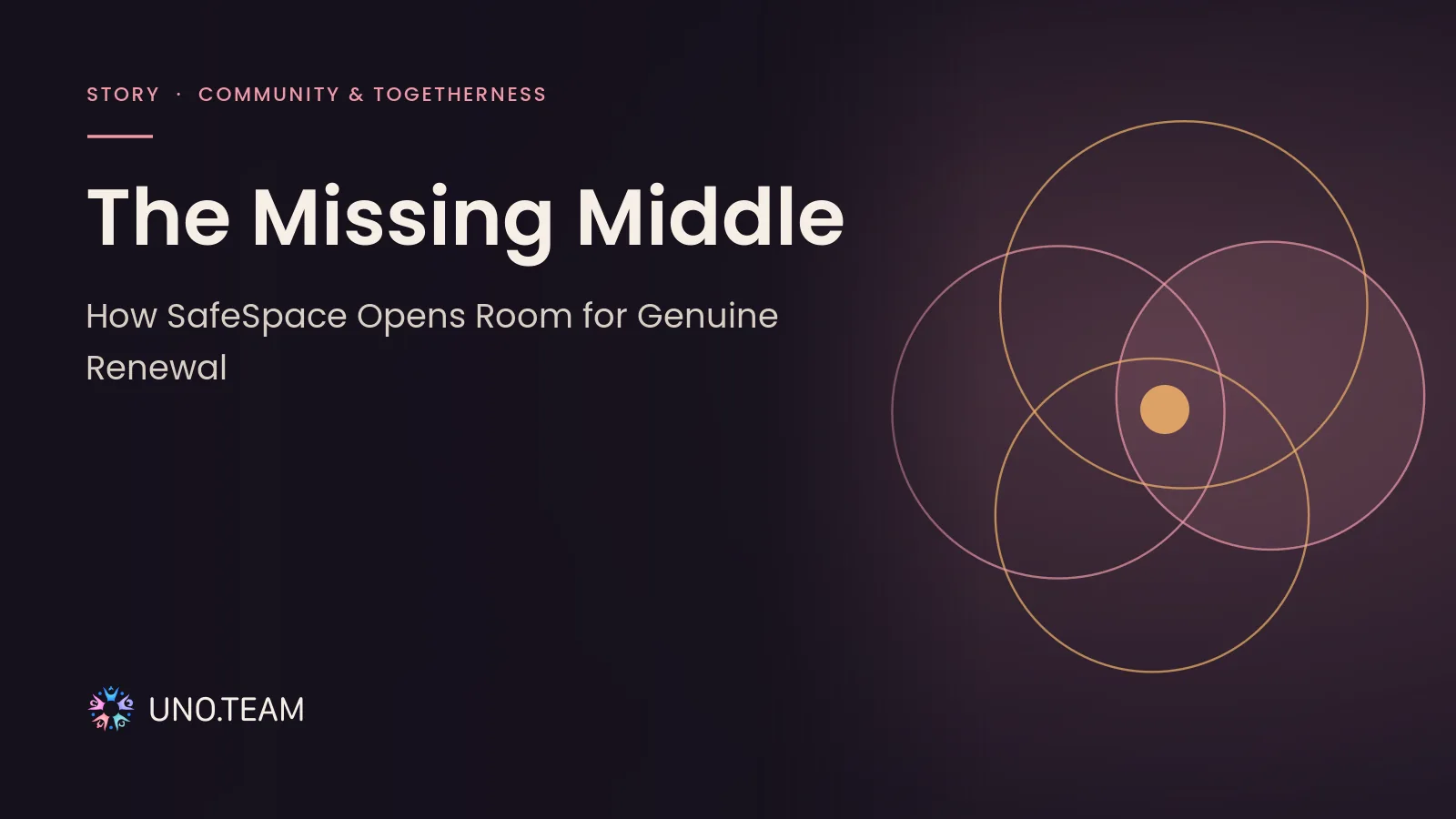
Against this background, it makes sense to pick up the central question once more and to look at well-being not just individually or structurally, but on three interconnected levels.
I — What is happening with me right now? What do I need? Where are my boundaries? Which decisions can I make, and which do I want to make?
We — What is happening between us? Can we listen? Can we disagree? Are boundaries respected? Can someone change their mind? Can we ask for support?
Is there trust, reciprocity and belonging?
Structure — Under what conditions does all of this take place? Who decides? Who has time and resources? Who carries responsibility and risk? Which work stays invisible? Which behaviours get rewarded?
And who can actually afford to say no?
None of these levels explains everything. But each one influences what is possible on the others.
Not every difficulty is structural, but not every one is purely personal either. And some things only come into being between us.
A new angle can open up as soon as we widen a familiar question.
Instead of: How do I become more resilient?
→ Why does this situation need so much resilience?
Instead of: How do I set better boundaries?
→ What happens here when someone sets a boundary?
Instead of: How do I become more self-confident?
→ Is disagreement actually possible in this room?
Instead of: How do I reduce my stress?
→ Which conditions keep producing it?
Instead of: Why don't I feel I belong?
→ How do we create belonging together?
Instead of: What's wrong with me right now?
→ What is happening inside me, between us and around us?
That doesn't mean handing over our personal responsibility. Quite the opposite: we can take responsibility in more areas.
I can look after myself. I can pay attention to how I meet others. And together we can reflect critically on how individual behaviour, human encounters and social structures interlock – and so keep shaping the environment in which our well-being grows.
To meet these questions safely, we need a space where safety and belonging are possible.
Research on psychological safety, especially Amy Edmondson's work, looks at environments in which people can take interpersonal risks: asking a question, admitting a mistake, raising concerns or disagreeing, without being put down for it.
But how does such a space come about?
Maybe it's more of a practice than a physical place: the conscious attempt to create conditions in which people can perceive, speak, question and decide.
That can happen in a workshop. But just as much in a team meeting. In a friendship. In a community. In an organisation. Or in the way we make a decision.
A safe environment would then be no protected place apart from the world. It would be a way of shaping the spaces and relationships we already live and work in more consciously, together.
Maybe a space where disagreement is allowed is even safer than one where everyone only watches out for harmony.
The We keeps coming into being in small moments.
When we sharpen our awareness of how our relationships are shaped and how we influence one another, the central question becomes clearer: How do we really stand with each other, and how do these interactions shape what we do together? When we engage consciously with these dynamics, new paths to shared well-being can open up.
SafeSpace grew out of two real moments in our everyday work. In December 2025, Theresa read the very first version of our website and wrote to us: "You sound like a true safe space – reading this warmed my heart." At that moment, the term itself was completely new to me. Theresa was the first to name what our lived values of tolerance, respect, and eye-level connection feel like from the outside.
In March 2026 came the second spark: our trainer Elnura shared openly in our team chat that she was stepping back from her training to care for her mental well-being. That moment brought everything together: with "Humanity at Her Best" as our guiding motif at UNO.TEAM, caring for humanity begins right within our own circle. People who accompany and strengthen others thrive when their own inner strength is reliably nourished and held.
Originally, I planned to launch SafeSpace right away as a standalone platform, and registered safespace.uno along with several sister domains for that purpose. Soon it became clear how valuable deliberate intermediate steps are: by letting SafeSpace grow first under the shared roof of UNO.TEAM, we are placing the project step by step onto a strong, enduring foundation.
The SafeSpace project grew out of these reflections.
Not as the answer to mental health. Not as a substitute for therapy or professional psychological support. And not with the idea that a workshop can change social structures.
For now, SafeSpace is an experimental space that wants to make the interpersonal and structural conditions for well-being tangible and shapeable. In a protected setting, participants explore how collective action can unfold the conditions for safety, belonging and mutual support. This can happen through exercises in mindful communication, sharing rounds free of performance pressure, and open conversations about needs, boundaries and expectations. In this way, we want to turn individual perceptions into concrete shared experiences, so that collective practices of being together can emerge.
With our first format, Nothing to Perform, we started with a very simple question: What happens when, for a while, we don't have to achieve, present or accomplish anything?
What happens inside me when nothing is expected of me?
What happens between us when nobody has to perform?
And which conditions do we need for such a space to come into being at all?
And with that, the same three levels show up again: I. We. Structure.
Maybe our project won't change social structures just yet. But through workshops, conversations and community, new forms of working together can emerge – maybe even things we can't imagine today.
In the end, it isn't about a protected space. It's about what we can concretely do to grow together as a community and strengthen each other, guided by one overarching question:
Which concrete conditions can we create ourselves to genuinely foster and enable well-being, self-determination, connection and participation?
Maybe we have learned to look inward.
Maybe we are just beginning to look more closely at the structures around us.
But in between, there is a level we shape together every single day.
The We.
And maybe that is exactly where a new question about mental health begins:
Not only: What do I have to change about myself?
Not only: What has to change in the system?
But also: How do we want to meet each other?
| Clinical therapy | Public digital platforms | SafeSpace: The Missing Middle | |
|---|---|---|---|
| Focus | Care in acute crises and clinical healing | Fast information, reach and public discourse | A space of renewal for people who carry a lot of responsibility |
| Access | Through diagnosis and referral | Always on, fast and publicly visible | Immediately accessible, protected and unhurried |
| Stance | Therapeutic treatment | Attention and exchange | Resonance between equals: rest as a natural source of strength |
| Carried by | The healthcare system | The platform economy | The community, in the spirit of a Community Economy (GemÖk) |
The term "Missing Middle" was coined by Natasa Dudar.
Many people carry great responsibility every day – in education, care, culture and teams. On the outside, everything runs reliably, while inside grows the wish for a place where every expectation may rest. SafeSpace offers that permission: to pause, feel your own rhythm, and choose what nourishes you right now.
Upcoming gatherings, the Wednesday walk and frequently asked questions: SafeSpace: Room to Breathe →